

APPLICATIONS / DRINKING WATER
Drinking water remineralisation and pH adjustment
Remineralisation and pH adjustment are used to adjust the physico-chemical balance of water in order to obtain stable water before distribution. They may be required when water naturally has a low mineral content or when its characteristics have been modified by upstream treatment stages.
Alkalinisation, calcium addition and pH adjustment contribute in particular to improving the buffering capacity of the water, controlling its calcium-carbonate equilibrium and limiting its aggressiveness towards treatment facilities and distribution networks.
Sodimate supports operators, engineering firms and plant manufacturers in the storage, dosing, preparation and injection of powder reagents used for these applications.
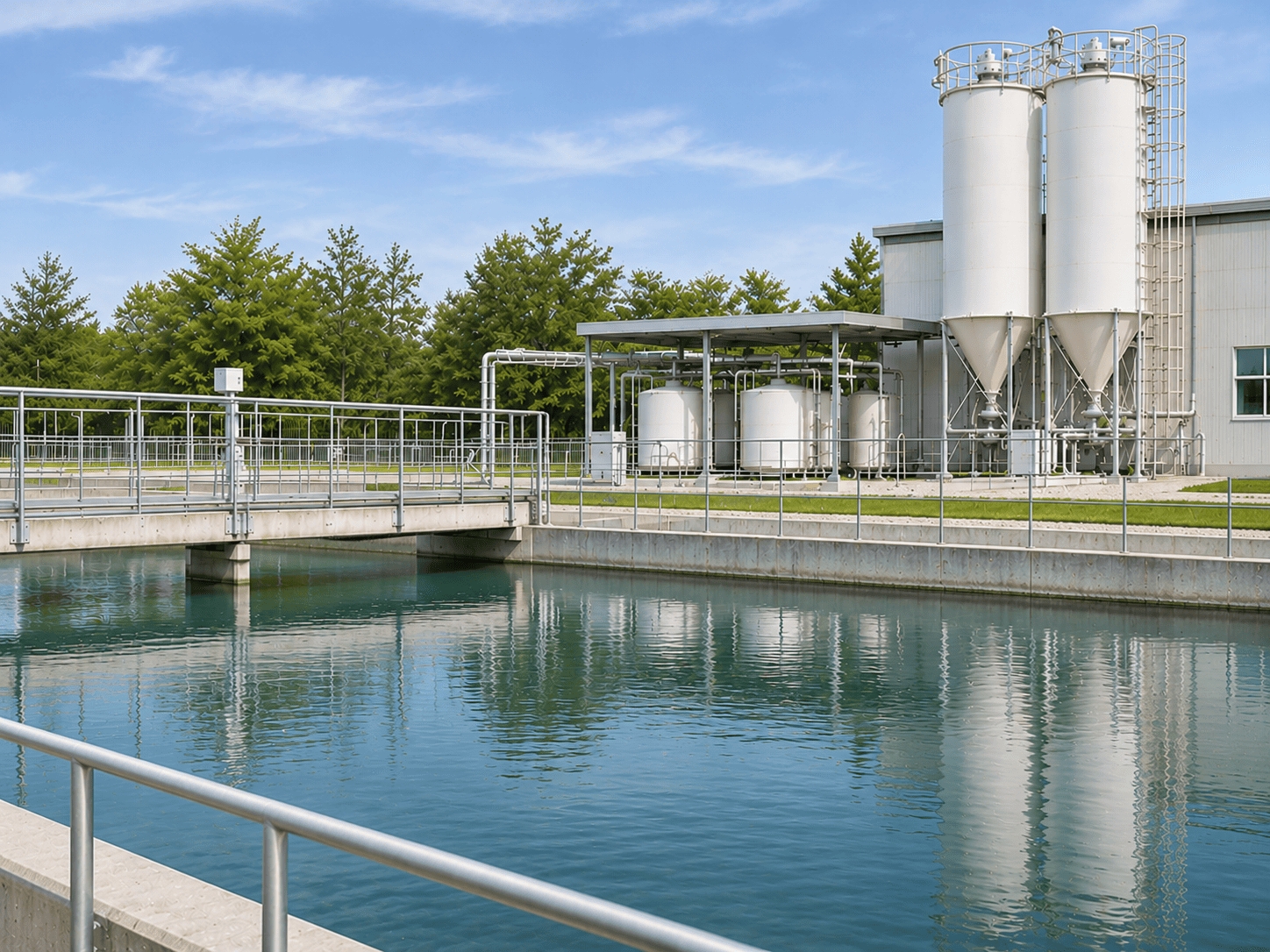
Why remineralise drinking water?
The mineral composition of water plays an important role in its physico-chemical stability.
Some water sources naturally have a low mineral content. Certain treatment stages can also modify the mineral balance of the water and result in insufficient alkalinity, hardness or buffering capacity.
Insufficiently mineralised water may therefore be aggressive towards the materials with which it comes into contact.
Remineralisation aims to restore an appropriate balance before the water is distributed. Depending on the initial characteristics of the water and the treatment objectives, it can in particular:
- add calcium;
- increase alkalinity;
- improve buffering capacity;
- stabilise pH;
- contribute to the calcium-carbonate equilibrium of the water; and
- limit the risk of corrosion in distribution networks.
The target parameters are defined according to the quality of the water to be treated, the treatment process and the quality objectives established for the distributed water.
Remineralisation, alkalinisation and pH adjustment: what are the differences?
These three concepts are closely related but address different objectives.
Remineralisation consists of modifying the mineral composition of the water, particularly by adding calcium and/or compounds that contribute to its alkalinity.
Alkalinisation primarily aims to increase the alkalinity of the water in order to improve its buffering capacity and limit variations in pH.
pH adjustment consists of modifying the acid-base balance of the water to achieve the required value for treatment stages or distribution.
As these parameters are interdependent, the choice of treatment is not based solely on a target pH value. It must take into account the composition of the water and its overall balance.
How does drinking water remineralisation work?
The process consists of introducing one or more reagents into the water to adjust the required parameters.
Depending on the water quality and the selected reagent, the treatment can increase pH, alkalinity or calcium content and thereby improve water stability.
When hydrated lime is used, it is generally dosed in powder form and then mixed with water to prepare lime milk. This suspension is then transferred and injected into the process at a flow rate adapted to the treatment requirements.
Controlling lime dosage and lime milk concentration contributes to consistent process feeding and to adjusting the characteristics of the produced water.
Reagent storage
Discharge and dosing
Lime milk preparation
Injection
Alkalinisation / pH adjustment
Stabilised water
The role of lime in alkalinisation and pH adjustment
Lime is widely used in drinking water treatment processes to increase pH and alkalinity.
Hydrated lime
Hydrated lime, or calcium hydroxide (Ca(OH)₂), provides calcium and hydroxide ions when introduced into water.
It can in particular:
- increase pH;
- increase alkalinity;
- add calcium; and
- contribute to the stabilisation of aggressive water.
To facilitate its handling and ensure consistent process feeding, powdered hydrated lime is generally prepared as lime milk.
Quicklime
Quicklime, or calcium oxide (CaO), can also be used. It must first be slaked with water to produce hydrated lime, which is then used to prepare the lime milk required for treatment.
This configuration may in particular be selected for installations with high lime consumption.
The choice between quicklime and hydrated lime depends on several parameters, including reagent consumption, available storage capacity, operating requirements and plant configuration.
Why prepare lime as lime milk?
Lime milk is an aqueous suspension obtained by mixing hydrated lime with water.
Its preparation produces a suspension that can be transferred and then injected into the treatment process in a controlled manner.
The quality of this preparation depends in particular on:
- lime dosage;
- the lime-to-water ratio;
- mixing efficiency;
- maintaining the lime in suspension; and
- consistent process feeding.
Agitation helps limit lime settling in the tank and maintain a sufficiently homogeneous suspension for transfer.
This control is important because lime has specific handling characteristics, and lime milk can generate deposits or fouling when preparation and transfer conditions are not suitable.
Protecting distribution networks
pH adjustment is not solely intended to achieve a specific value at the treatment plant outlet.
Maintaining water stability during transport through distribution networks is also a major consideration.
Water with insufficient alkalinity and buffering capacity may be more sensitive to pH variations and may be aggressive towards certain materials. It can promote corrosion and, depending on the conditions encountered, the release of certain metals into the water.
Conversely, inadequately balanced water can also promote precipitation and deposit formation.
Remineralisation and alkalinisation therefore aim to achieve an appropriate balance between pH, alkalinity, hardness and water composition in order to contribute to its stability through to the point of distribution.
Reagents used for remineralisation and pH adjustment
Several reagents can be used depending on the initial composition of the water and the parameters to be adjusted.
Hydrated lime (Ca(OH)₂) is used to increase pH, increase alkalinity and add calcium.
Quicklime (CaO), after slaking, can also be used to produce lime milk for treatment.
Calcium carbonate (CaCO₃) can be used in certain remineralisation processes to add calcium and contribute to the calcium-carbonate equilibrium.
Sodium bicarbonate (NaHCO₃) can be used when the objective is, in particular, to increase the alkalinity and buffering capacity of the water.
Other reagents may be used depending on the water characteristics and treatment objectives.
The choice of reagent depends in particular on:
- water composition;
- initial and target pH;
- alkalinity;
- required hardness;
- selected process; and
- operating constraints.

Quicklime

Hydrated lime
Equipment used for reagent handling
Consistent reagent preparation and feeding contribute directly to treatment stability.
Depending on the reagent and plant configuration, Sodimate solutions can provide:
- storage of the powder reagent;
- consistent reagent discharge;
- dosing;
- preparation of lime milk or a solution;
- maintenance of the reagent in suspension; and
- transfer and injection into the process.
The equipment can be installed individually or integrated into a complete system adapted to reagent consumption and site constraints. Storage can also be adapted to the product packaging and supply method: silo, Big Bag or sacks.
Main challenges of remineralisation and pH adjustment
Treatment stability depends on water quality, reagent selection and consistent reagent handling.
Variability in water quality
Adapt the treatment to the physico-chemical characteristics of the water.
Reagent dosing
Maintain consistent feeding according to the treatment objectives.
Lime milk preparation
Ensure a homogeneous suspension suitable for injection.
pH and alkalinity control
Achieve the required parameters while maintaining appropriate buffering capacity.
Water stability
Maintain the appropriate physico-chemical balance before distribution.
Protection of distribution networks
Limit corrosion or deposit formation associated with inadequately balanced water.
FAQ on remineralisation and pH adjustment
Why remineralise drinking water?
Remineralisation adjusts the mineral composition of water with insufficient alkalinity or hardness. It contributes to stabilising pH, improving the buffering capacity of the water and limiting its aggressiveness towards distribution networks.
What is the difference between remineralisation and pH adjustment?
pH adjustment aims to modify the acid-base balance of the water. Remineralisation acts more broadly on its mineral composition and can in particular modify its calcium content, alkalinity and buffering capacity. Both operations can be combined within the same treatment process.
Why is lime milk used for pH adjustment?
Lime milk enables hydrated lime to be handled as an aqueous suspension that can be dosed and injected into the process. Lime increases pH and alkalinity while also adding calcium.
What is the role of alkalinity in drinking water?
Alkalinity represents the capacity of water to neutralise acid inputs and contributes to its buffering capacity. Appropriate alkalinity helps limit pH variations and maintain water stability within treatment facilities and distribution networks.
How does remineralisation help protect distribution networks?
By adjusting parameters including pH, alkalinity, hardness and calcium-carbonate equilibrium, remineralisation helps limit water aggressiveness and phenomena that may affect pipelines and equipment.
Remineralisation and pH adjustment projects
Sodimate solutions are used in drinking water treatment plants for the preparation, dosing and injection of reagents used for remineralisation, alkalinisation and pH adjustment.
Each project illustrates how the equipment is adapted to reagent characteristics, water quality objectives and the operating constraints specific to each installation.
Sodimate references include lime dosing and lime milk preparation installations for remineralisation and pH adjustment. In Saint-Brieuc, for example, two discharge and dosing lines beneath storage silos feed hydrated lime used for these applications.
Looking for a solution for your remineralisation or pH adjustment process?
Each project presents specific constraints relating to water quality, the parameters to be adjusted, the reagent used and operating conditions.
Sodimate teams support you in assessing your project, sizing the equipment and integrating it into your installation, from reagent storage through to its preparation and injection into the process.