

APPLICATIONS / DESALINATION
Sludge conveying in desalination plants
Desalination plants can generate sludge during the various pretreatment stages carried out upstream of reverse osmosis. After concentration and dewatering, this sludge must be collected and transferred to a storage or disposal area.
Its flow rate, dry solids content and consistency require suitable handling equipment to ensure consistent transfer and limit the risk of material build-up or process interruption.
Sodimate designs conveying solutions for the collection and transfer of dewatered sludge in desalination plants.
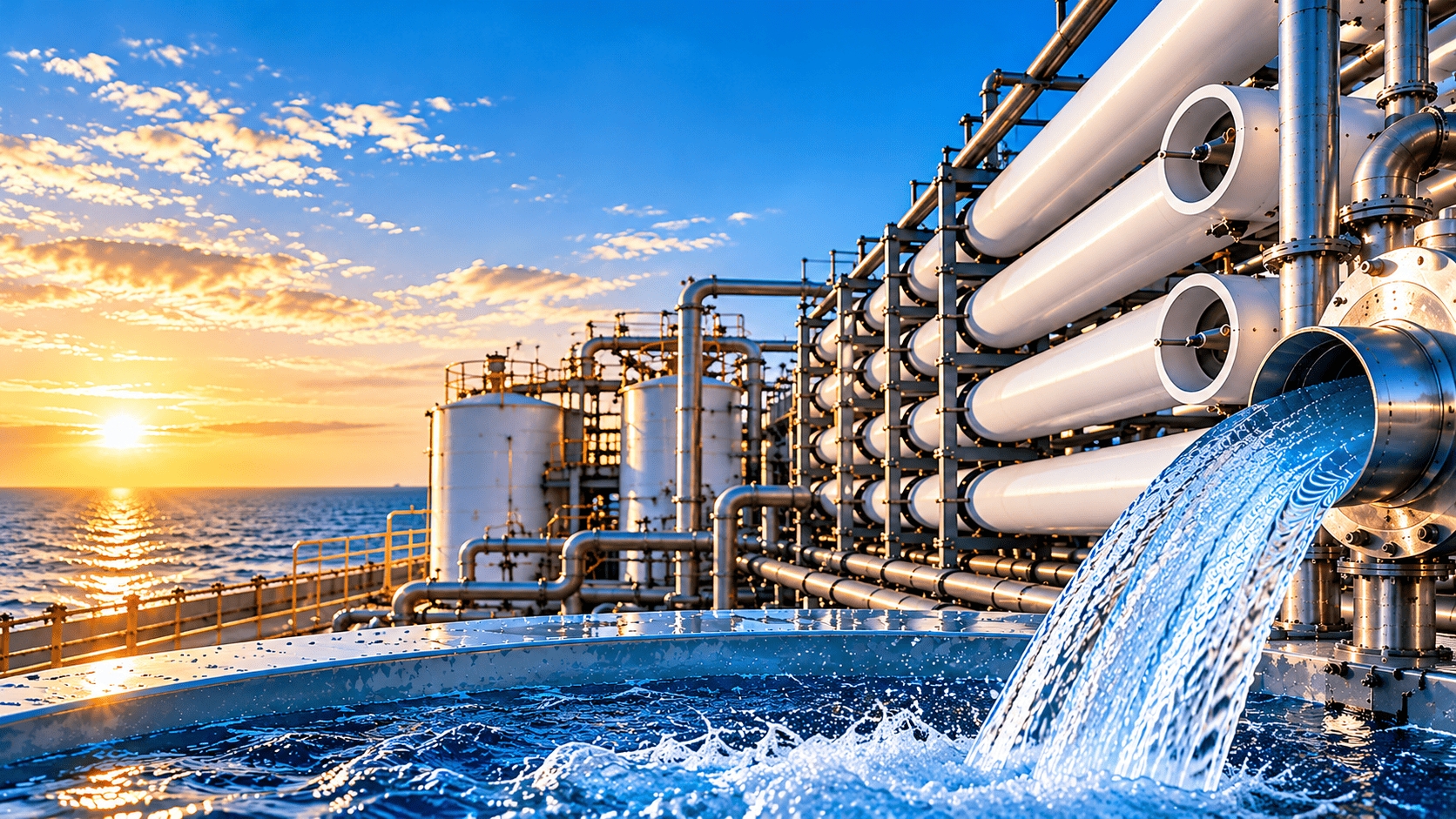
Where does sludge come from in a desalination plant?
Before passing through the reverse osmosis membranes, seawater or brackish water undergoes pretreatment to control suspended solids and certain compounds that may affect membrane performance.
Depending on the raw water quality and plant configuration, this pretreatment may combine different physical separation and physico-chemical treatment stages.
The materials separated from the water during these treatment stages may be concentrated in the form of sludge. The quantity and characteristics of this sludge vary depending in particular on:
- raw water quality;
- pretreatment technology used;
- reagents used, where applicable;
- plant flow rate; and
- operating conditions.
The sludge is then treated to reduce its water content and volume before disposal.
Seawater / brackish water
Pretreatment
Separation of materials
Sludge
Concentration
Dewatering
Conveying
Storage / disposal
Why dewater sludge before conveying?
Dewatering separates part of the water contained in the sludge in order to reduce its volume and increase its dry solids content.
The resulting sludge has a different consistency from the liquid sludge upstream. Depending on the dewatering technology and sludge characteristics, it may form a pasty, cohesive or more compact material that must be mechanically collected.
This stage facilitates sludge handling, storage and disposal, but its mechanical properties must be taken into account when selecting the conveying equipment.
The characteristics of the sludge after dewatering — particularly its flow rate, dry solids content and consistency — are therefore essential data for sizing the transfer system.
How is dewatered sludge conveyed?
Once dewatered, the sludge must be collected at the outlet of the dewatering equipment and then conveyed to its destination.
Mechanical conveying can provide continuous or intermittent transfer depending on plant operation.
Sludge conveyors can in particular be used for:
- collection beneath the dewatering equipment;
- horizontal or inclined sludge transfer;
- connection between several items of equipment;
- feeding of a skip or storage equipment; and
- distribution of sludge between several discharge points depending on the plant configuration.
Conveyors specifically designed for sludge are intended to handle materials with a pasty or dewatered consistency, unlike conventional screw conveyors primarily intended for powder or granular products.
Dewatering equipment
Sludge collection
Conveyor
Transfer
Skip / storage / disposal
Which parameters should be considered for sludge conveying?
The sizing of a conveying system must be adapted to the actual sludge characteristics and plant configuration.
Several parameters must be taken into account:
Sludge flow rate
Determine the required transfer capacity under normal operating conditions and during variations in sludge production.
Dry solids content
Take into account the dry solids content of the sludge after dewatering.
Consistency / corrosiveness
Adapt the conveyor to the pasty, cohesive or compact behaviour of the sludge and to its composition, with materials such as 316 stainless steel or Super Duplex where required.
Transfer distance
Size the conveying system according to the required distance between the dewatering equipment and the discharge point.
Conveying route configuration
Take into account horizontal transfer, inclines, changes in elevation and installation constraints.
Operating mode
Adapt the conveyor for continuous or intermittent operation according to the process.
Conveying between dewatering and storage
The layout of the conveying system depends on the arrangement of the dewatering equipment and the sludge destination.
In a simple configuration, a conveyor can directly collect the sludge beneath the dewatering equipment and transfer it to a skip or storage area.
Installations with greater layout constraints may require several successive items of equipment to accommodate changes of direction, differences in elevation or sludge distribution between several discharge points.
The conveying system must therefore be designed to ensure consistent sludge removal while fitting within the available space and the overall operation of the installation.
Dewatering
collection conveyor
transfer conveyor
storage
Equipment used for sludge conveying
Sodimate designs equipment for the collection and transfer of dewatered sludge, taking into account sludge characteristics and site layout constraints.
The conveyors can be integrated into both new installations and modernisation projects, adapting to the existing configuration and equipment.
Main challenges of sludge conveying in desalination plants
Transfer reliability depends both on sludge characteristics and on the mechanical integration of the conveying system within the installation.
Sludge variability
Adapt the equipment to variations in flow rate, dry solids content and consistency.
Collection after dewatering
Ensure consistent sludge removal at the outlet of the dewatering equipment.
Conveying pasty sludge
Maintain reliable transfer despite the consistency and mechanical behaviour of the sludge.
Installation constraints
Adapt the conveyor route to the plant configuration and available space.
Storage and disposal
Ensure consistent feeding of skips or storage areas.
Continuity of operation
Limit sludge build-up that could disrupt line operation.
FAQ on sludge conveying in desalination plants
Where does sludge come from in a desalination plant?
Sludge can be generated during the pretreatment stages carried out before reverse osmosis. Its quantity and characteristics depend in particular on raw water quality, treatment technology and operating conditions.
Why dewater sludge before conveying?
Dewatering reduces the water content and volume of the sludge. It produces sludge with a dry solids content and consistency that allow it to be collected using suitable mechanical handling equipment.
How can dewatered sludge be conveyed?
Conveyors specifically designed for sludge can collect it at the outlet of the dewatering equipment and transfer it to a skip, storage area or disposal point.
Which parameters influence the sizing of a sludge conveyor?
Sizing depends in particular on the sludge flow rate, composition, dry solids content and consistency, the transfer distance and difference in elevation, as well as the plant configuration.
Can a sludge conveyor operate continuously?
Yes. Depending on process requirements and operating conditions, conveyors can be designed for continuous or intermittent operation.
Sludge conveying projects
Sodimate solutions can be integrated into desalination plants to collect and transfer sludge after dewatering.
Each project requires the equipment to be adapted to the sludge characteristics, the flow rate to be conveyed, the dewatering technology and the site layout constraints.
Looking for a sludge conveying solution for your desalination plant?
Each installation presents specific constraints related to sludge characteristics, dewatering technology, transfer flow rates and site configuration.
Sodimate teams support you in assessing your project, sizing the equipment and integrating it into the installation, from sludge collection after dewatering through to its transfer to the storage or disposal area.