

APPLICATIONS / DRINKING WATER
Drinking water sludge handling
Drinking water production processes generate sludge, particularly during clarification, decarbonation and filter backwashing stages. After thickening, conditioning and dewatering, this sludge must be collected, transferred and directed to storage, disposal or recovery.
Depending on its characteristics and final destination, the sludge may also undergo lime treatment to improve its stability and physical properties.
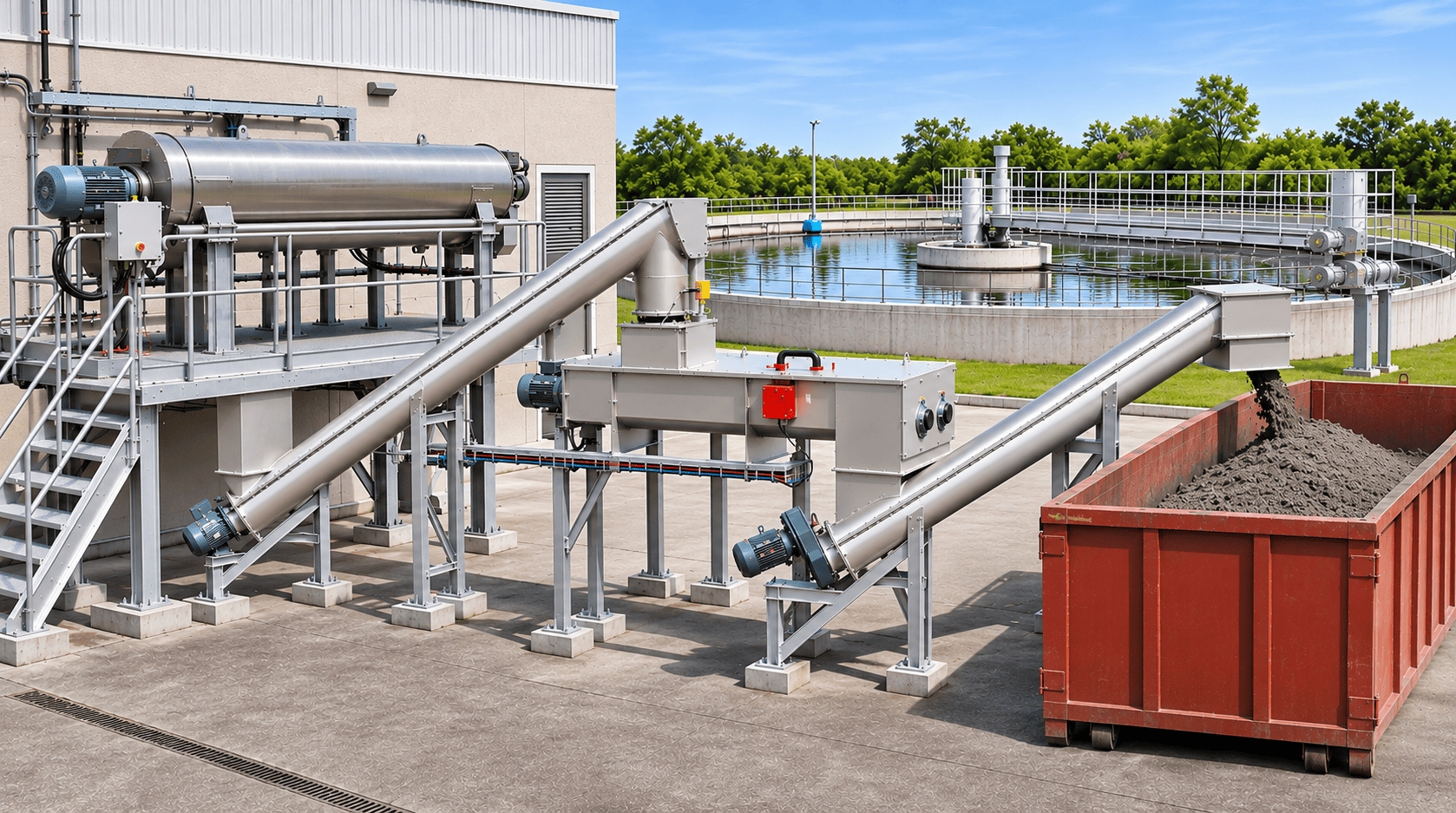
Sodimate designs solutions for handling dewatered sludge, from collection beneath the dewatering equipment through to conveying to storage areas, including, where required by the process, lime dosing and sludge/lime mixing.
Where does sludge produced in drinking water treatment plants come from?
Drinking water production generates solid materials during the different treatment stages used to remove compounds present in the raw water.
Depending on the treatment process, sludge may in particular originate from:
- clarification and settling;
- decarbonation; and
- filter backwashing.
This sludge is generally concentrated before undergoing conditioning and dewatering stages designed to reduce its water content and volume.
From sludge conditioning to dewatering
Before handling, sludge generated during drinking water production is generally thickened, conditioned and then dewatered to reduce its water content and volume.
Conditioning prepares the sludge for dewatering and promotes separation between water and solids. Depending on the sludge characteristics and the dewatering technology used, conditioning reagents may be added to improve the performance of this stage.
Dewatering then increases the dry solids content of the sludge and reduces the volumes to be handled, stored and disposed of. It can in particular be carried out using centrifuges, filter presses or belt filter presses.
The characteristics of the resulting sludge — flow rate, dry solids content, consistency and mechanical behaviour — directly determine the selection and sizing of the equipment used for its collection and conveying.
How is sludge handled after dewatering?
After dewatering, the sludge must be discharged from the equipment, collected and then transferred to its final destination.
Its pasty consistency and dry solids content make its handling different from that of a liquid or powder product.
The process generally includes:
- collection of the sludge beneath the dewatering equipment;
- sludge conveying;
- where applicable, the addition of lime and homogeneous mixing of the sludge and reagent;
- sludge transfer; and
- distribution to a skip, silo or storage area.
The conveyor configuration depends in particular on the sludge flow rate, dry solids content, dewatering technology, transfer distance and overall plant layout.
Sludge dewatering
Sludge collection
Conveying
Lime treatment and mixing, where required
Transfer
Storage / disposal
Why use lime treatment for drinking water sludge?
Lime treatment can be carried out on dewatered sludge before storage or disposal.
It consists of incorporating lime into the sludge to modify its physico-chemical characteristics.
Depending on the operating conditions and treatment objectives, lime treatment can:
- stabilise the sludge by limiting fermentation and odour generation;
- contribute to sludge hygienisation;
- increase its dry solids content;
- improve its mechanical properties and suitability for storage; and
- facilitate subsequent handling and recovery.
Lime treatment is particularly beneficial for sludge with a pasty consistency after dewatering when improved mechanical properties are required before storage or disposal.
The role of quicklime in sludge treatment
Quicklime (CaO) is commonly used for the lime treatment of dewatered sludge.
When it comes into contact with the water contained in the sludge, it undergoes an exothermic hydration reaction. This reaction contributes to modifying the properties of the sludge and, combined with the increase in pH, helps achieve stabilisation objectives and, under appropriate conditions, hygienisation.
The addition of lime can also increase the dry solids content and improve the structure of the sludge, facilitating its storage and handling.
To achieve consistent treatment, the lime must be discharged and dosed in a controlled manner and then distributed homogeneously throughout the sludge.
Mixing quality is therefore an essential process parameter. Intimate mixing between the sludge and quicklime promotes homogeneous distribution of the reagent and a consistent reaction throughout the sludge mass.
How does a sludge liming system work?
A sludge liming system combines the handling of a powder reagent with the handling of dewatered sludge with a pasty consistency.
The lime is stored in a silo, Big Bag or sacks according to consumption requirements and supply constraints. It is then discharged and dosed before being introduced into the sludge flow.
Sludge from the dewatering equipment is collected by a conveyor and then fed to the mixer.
In the mixer, the sludge and lime are mixed to achieve homogeneous distribution of the reagent. The lime-treated sludge is then collected and conveyed to the storage area or disposal system.
Lime storage
Discharge and dosing
Lime introduction
Sludge/lime mixer ← Dewatered sludge
Lime-treated sludge conveying
Skip / silo / storage area
Dewatered sludge conveying
The transfer of dewatered sludge requires equipment adapted to its consistency and mechanical behaviour.
Shaftless screw conveyors can collect sludge directly beneath the dewatering equipment and transfer it between the different stages of the installation.
They can in particular provide:
- collection beneath a centrifuge, filter press or belt filter press;
- feeding of a mixer;
- transfer after lime treatment;
- sludge elevation; and
- distribution to several skips or storage areas.
The layout is adapted to site constraints and the required transfer distances.
Sodimate uses its CS sludge transfer conveyors in particular in combination with its lime dosing installations and mixers, from dewatering through to sludge storage.
Mixing lime and sludge
The effectiveness of lime treatment depends on the quality of contact between the lime and the sludge.
Insufficient reagent distribution can result in heterogeneous treatment and areas of sludge with different characteristics.
Mixing therefore aims to ensure consistent incorporation of the lime while maintaining the characteristics required for sludge handling.
Sodimate MBV sludge mixers use paddles whose configuration can be adapted to the sludge flow rate and characteristics. The installation can be fed and discharged by screw conveyors to form a continuous line between dewatering, treatment and storage.
Sludge storage, disposal and recovery
After dewatering and, where required by the process, lime treatment, the sludge is transferred to a storage area before disposal.
Its final destination depends on its characteristics, the treatments applied and the available disposal or recovery options. Handling conditions must therefore be taken into account from the installation design stage to ensure consistent sludge transfer through to its final destination.
Lime treatment can help improve sludge stability, dry solids content and mechanical properties, thereby facilitating storage, handling and, where sludge characteristics and applicable regulations allow, its subsequent recovery.
Depending on the site configuration, conveying equipment can transfer and distribute the sludge to a skip, silo or storage area before disposal.
Equipment used for sludge handling and lime treatment
Depending on the installation configuration, Sodimate solutions can provide:
- sludge collection after dewatering;
- transfer between the different process stages;
- lime storage, discharge and dosing;
- reagent introduction;
- homogeneous mixing of lime and sludge; and
- transfer of treated sludge to storage.
This equipment can be integrated into a complete installation or adapted to an existing installation.
CS sludge transfer conveyor
Collection and transfer of dewatered or lime-treated sludge.
Discover the equipment →
MBV sludge and lime mixer
Mixing of lime with dewatered sludge.
Discover the equipment →
Mechanical bin activator with metering conveyor
Consistent lime discharge and dosing.
Discover the equipment →
Storage silo
Storage of the lime used for treatment.
Discover the equipment →
Main challenges of drinking water sludge handling
The design of a sludge handling installation depends on the sludge characteristics, the selected treatment and the site layout.
Sludge variability
Adapt the equipment to variations in flow rate, dry solids content and consistency.
Collection after dewatering
Ensure consistent sludge removal beneath a centrifuge, filter press or belt filter press.
Conveying pasty sludge
Maintain reliable transfer despite the mechanical properties of the sludge.
Lime dosing
Adapt the quantity of reagent to the sludge flow rate and characteristics.
Mixing homogeneity
Distribute the lime throughout the sludge mass.
Storage and disposal
Ensure consistent distribution of sludge to skips, silos or storage areas.
FAQ on drinking water sludge handling
Where does sludge from a drinking water treatment plant come from?
Drinking water sludge mainly originates from clarification, decarbonation and filter backwashing stages. It is generally thickened, conditioned and then dewatered before handling, storage or disposal.
Why condition sludge before dewatering?
Conditioning prepares the sludge for dewatering and promotes separation between water and solids. Depending on the sludge characteristics and the technology used, the addition of conditioning reagents can help improve dewatering performance.
How can dewatered sludge be conveyed?
Dewatered sludge generally has a pasty consistency. Shaftless screw conveyors can be used to collect it beneath the dewatering equipment and transfer it to a mixer, skip, silo or storage area.
Why add lime to drinking water sludge?
Lime treatment can stabilise the sludge, limit fermentation and odour generation, increase its dry solids content and improve its mechanical properties. Under certain treatment conditions, it also contributes to sludge hygienisation.
Why use quicklime for sludge liming?
Quicklime reacts with the water contained in the sludge through an exothermic hydration reaction. It contributes to increasing the pH, stabilising the sludge and improving some of its physical characteristics.
Which parameters should be considered when sizing a sludge conveying system?
Sizing depends in particular on the sludge flow rate, dry solids content and consistency, the type of dewatering equipment, the transfer distance and elevation difference, as well as the configuration of the storage area.
Drinking water sludge handling projects
Sodimate solutions are used in drinking water treatment plants for the collection, conveying and, where required by the process, lime treatment of dewatered sludge.
Each project illustrates how the equipment is adapted to sludge characteristics, dewatering technologies, required flow rates and the layout constraints specific to each installation.
Sodimate has drinking water references that include complete systems combining lime dosing, mixing and sludge conveying, as well as installations dedicated to sludge transfer after dewatering.
Looking for a solution for handling sludge from your drinking water treatment plant?
Each installation presents specific constraints relating to sludge characteristics, dewatering technology, required flow rates and final destination.
Sodimate teams support you in assessing your project, sizing the equipment and integrating it into the installation, from sludge collection after dewatering through to lime treatment, where required, and transfer to storage.