

APPLICATIONS / DRINKING WATER
Clarification and drinking water production
Clarification is an important stage in many drinking water production processes. It removes a large proportion of the suspended solids and particles present in raw water before the subsequent treatment stages.
The process generally combines several successive operations involving coagulation, flocculation and separation of the resulting solids. Depending on the selected technology, different reagents may be used to promote particle aggregation and their separation from the water.
Sodimate supports operators, engineering firms and plant manufacturers in the preparation, dosing and handling of reagents used in these clarification processes.
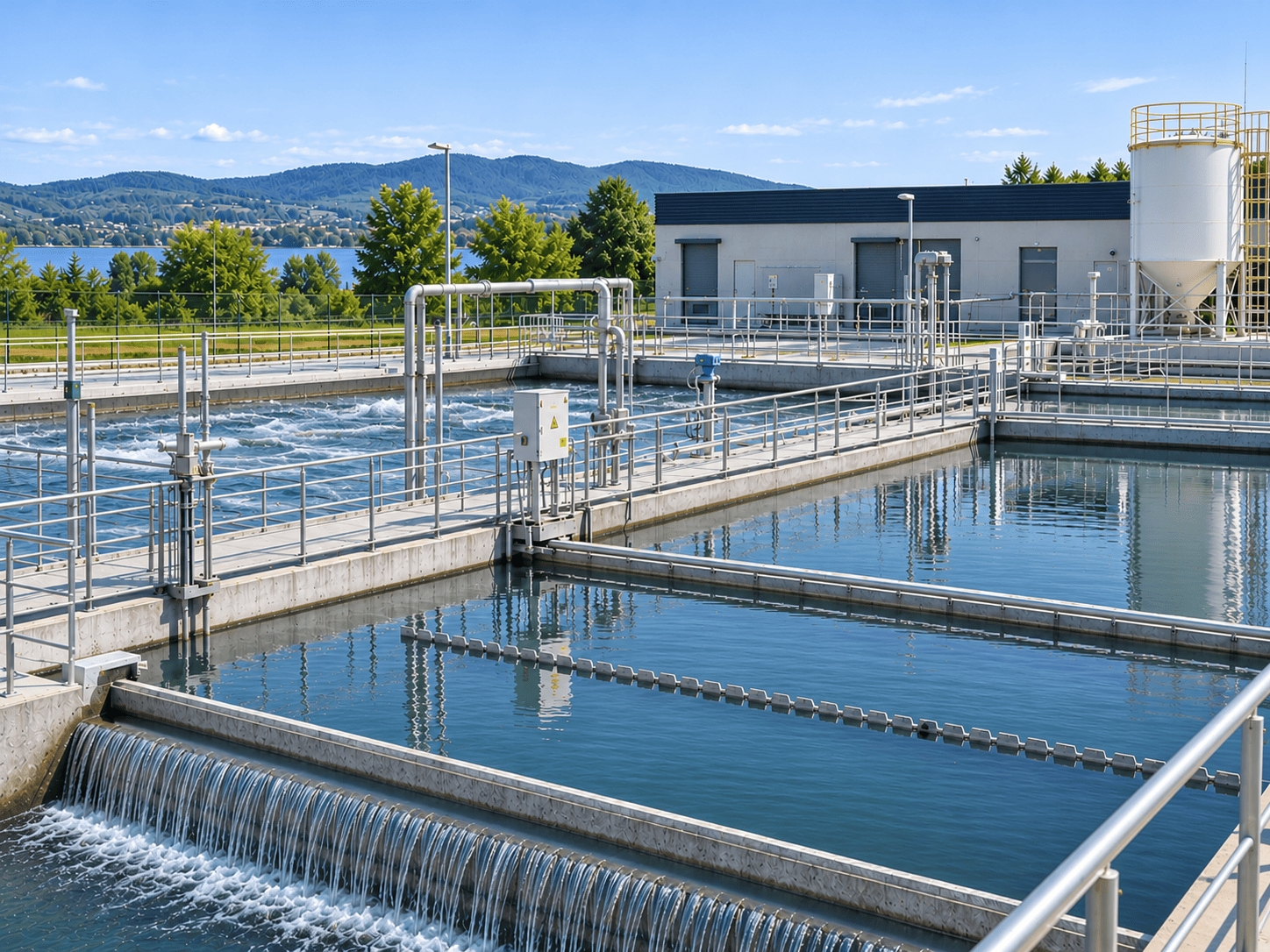
Why clarify water intended for drinking water production?
Raw water can contain suspended solids, mineral or organic particles, colloids and various compounds that may affect its turbidity and quality.
Some of these particles can be separated naturally by settling. Colloidal particles, however, are generally too fine and too stable to be effectively removed by gravity separation alone.
Clarification aims to destabilise these particles and then promote their aggregation to form flocs that can be separated from the water.
Clarification can in particular:
- reduce turbidity;
- remove some of the suspended solids;
- reduce the load on downstream filtration stages;
- improve the operating conditions of subsequent treatment stages; and
- contribute to achieving the quality objectives defined for the produced water.
Clarification therefore forms part of a broader treatment process, the configuration of which depends on raw water characteristics and the required performance.
How does drinking water clarification work?
Clarification generally involves several successive physico-chemical stages designed to destabilise the particles present in the water, promote their aggregation and then separate them from the liquid phase.
The process generally includes:
- coagulation;
- flocculation;
- separation of flocs by settling; and
- removal of the resulting sludge.
Depending on raw water characteristics and the technology used, these stages may be supplemented by the use of polymers or ballasting materials designed to improve floc formation and separation.
Raw water
Coagulation
Flocculation
Clarification / Settling
Clarified water
Filtration and subsequent treatment stages
Clarification / Settling → Sludge → Sludge treatment
Coagulation: destabilising particles in the water
Coagulation is generally the first physico-chemical stage of the clarification process.
Colloidal particles present in water can remain suspended for long periods, particularly because of electrical charges on their surfaces that limit spontaneous aggregation. The addition of a coagulant destabilises these particles by reducing the forces that keep them in suspension, thereby promoting their interaction and aggregation.
The choice and dosage of the coagulant depend in particular on raw water characteristics, turbidity, pH and treatment objectives.
After coagulant injection, rapid mixing promotes its dispersion throughout the water and contact with the particles to be destabilised.
This stage directly influences floc formation during the subsequent flocculation stage.
Flocculation: promoting floc formation
Following coagulation, flocculation allows the destabilised particles to progressively aggregate and form larger flocs that can be more easily separated from the water.
This stage relies on controlled mixing. Mixing must promote contact between particles and floc growth while limiting shear forces that could cause the flocs to break apart.
Polymers can be used as flocculating agents to promote particle aggregation and improve the characteristics of the resulting flocs.
When polymers are used, their preparation and dosing are important parameters for process consistency. For powder polymers, wetting, dilution and maturation stages must produce a homogeneous solution before injection.
Separating flocs from the water
Once formed, the flocs must be separated from the water to remove the solids they have aggregated.
In conventional processes, this separation is generally based on gravity settling of the flocs in a clarifier or settling tank.
The resulting sludge accumulates in the lower part of the unit before being extracted and directed to the appropriate treatment stages. The clarified water continues to the subsequent stages of the drinking water production process, including filtration where applicable.
The performance of this stage depends in particular on the quality of the flocs formed, the hydraulic conditions within the unit and the control of the upstream coagulation and flocculation stages.
Main clarification technologies
Several clarification technologies can be used depending on raw water characteristics, the flow rates to be treated, required performance and plant layout constraints.
Conventional clarification
Conventional clarification is based on floc formation followed by separation through gravity settling.
The design of the treatment units and their hydraulic conditions allow the flocs to settle before sludge removal and recovery of the clarified water.
Ballasted floc clarification
Some installations use microsand to accelerate floc formation and settling.
Microsand acts as a ballasting material for the flocs, providing:
- faster clarification;
- higher settling velocities;
- more compact treatment units; and
- greater process stability when raw water quality varies.
This technology is used in ballasted clarification systems to improve clarification performance while reducing the footprint of the treatment units.
Reagents and materials used for clarification
The reagents and materials used depend on raw water characteristics, the selected clarification technology and the required performance.
Coagulants, flocculating agents and, depending on the process, ballasting materials are used at different stages of clarification. Their selection and controlled dosing are directly related to the characteristics of the water to be treated and the process objectives.
Aluminium sulphate for water coagulation
Aluminium sulphate is used as a coagulant in many water treatment processes. Its dosing destabilises colloidal particles and suspended solids, promoting their aggregation and subsequent separation during the clarification stages.
Consistent and accurate dosing is essential for effective process control. Sodimate designs and supplies solutions adapted to its storage, discharge and dosing, according to product characteristics and plant requirements.
Polymers for flocculation
When used as flocculating agents, polymers promote the aggregation of destabilised particles and the formation of flocs with characteristics suitable for separation.
Powder polymers require preparation stages including wetting, dilution and maturation before injection.
Microsand for ballasted floc clarification
In ballasted floc clarification processes, microsand acts as a ballasting material to increase the settling velocity of the flocs.
Its handling must provide feeding adapted to the operating requirements of the clarification process.

Powder polymers

Microsand
Equipment used for reagent and material handling
Consistent preparation and feeding of reagents and materials are important parameters for the operation of clarification processes.
Depending on the plant configuration and the products used, Sodimate solutions provide:
- storage of powder reagents;
- discharge and dosing;
- polymer preparation;
- preparation of solutions or suspensions;
- reagent transfer and injection; and
- microsand handling in the relevant processes.
This equipment can be installed individually or integrated into complete systems adapted to product characteristics and plant operating constraints.
Main challenges of drinking water clarification
The performance of a clarification process depends on raw water quality, coagulation and flocculation conditions, and consistent reagent handling.
Raw water variability
Adapt treatment to changes in water turbidity and composition.
Reagent dosing
Maintain consistent feeding adapted to process requirements.
Polymer preparation
Ensure homogeneous preparation before injection.
Floc formation
Maintain conditions that promote floc formation and growth.
Clarification performance
Ensure effective separation between the resulting solids and clarified water.
Sludge management
Ensure removal of the resulting sludge and transfer to the appropriate treatment stages.
FAQ on drinking water clarification
What is the difference between coagulation and flocculation?
Coagulation aims to destabilise fine and colloidal particles present in the water to enable their aggregation. Flocculation then promotes their aggregation and the formation of flocs large enough to be separated from the water.
What is the role of aluminium sulphate in water clarification?
Aluminium sulphate is used as a coagulant to destabilise colloidal particles and certain suspended solids present in the water. This destabilisation promotes their aggregation and the subsequent formation of flocs that can be separated during the following clarification stages.
Why are polymers used during flocculation?
Polymers can promote particle aggregation and contribute to the formation of flocs with characteristics suitable for separation. Their use and dosage depend on the process and the characteristics of the water to be treated.
What is the role of microsand in clarification?
In ballasted floc clarification processes, microsand acts as a ballasting material and helps increase the settling velocity of the flocs. This accelerates clarification and reduces the footprint of the treatment units.
Which parameters influence clarification performance?
Performance depends in particular on raw water characteristics, pH, the type and dosage of reagents, mixing conditions, floc formation and the clarification technology used.
Clarification and drinking water production projects
Sodimate solutions are used in drinking water treatment plants incorporating different clarification technologies.
Each project illustrates how Sodimate solutions are adapted to raw water characteristics, the reagents used, required performance and the operating constraints specific to each plant.
These references illustrate the diversity of coagulation-flocculation processes, clarification technologies and plant configurations encountered in drinking water treatment plants.
Looking for a solution for your clarification process?
Each clarification project presents specific constraints relating to raw water quality, the selected technology, the reagents used and the required performance.
Sodimate teams support you in assessing your project, sizing the equipment and integrating it into your installation according to the reagents used and the requirements of your process.